Category Archives: FX

Time to Think FX…

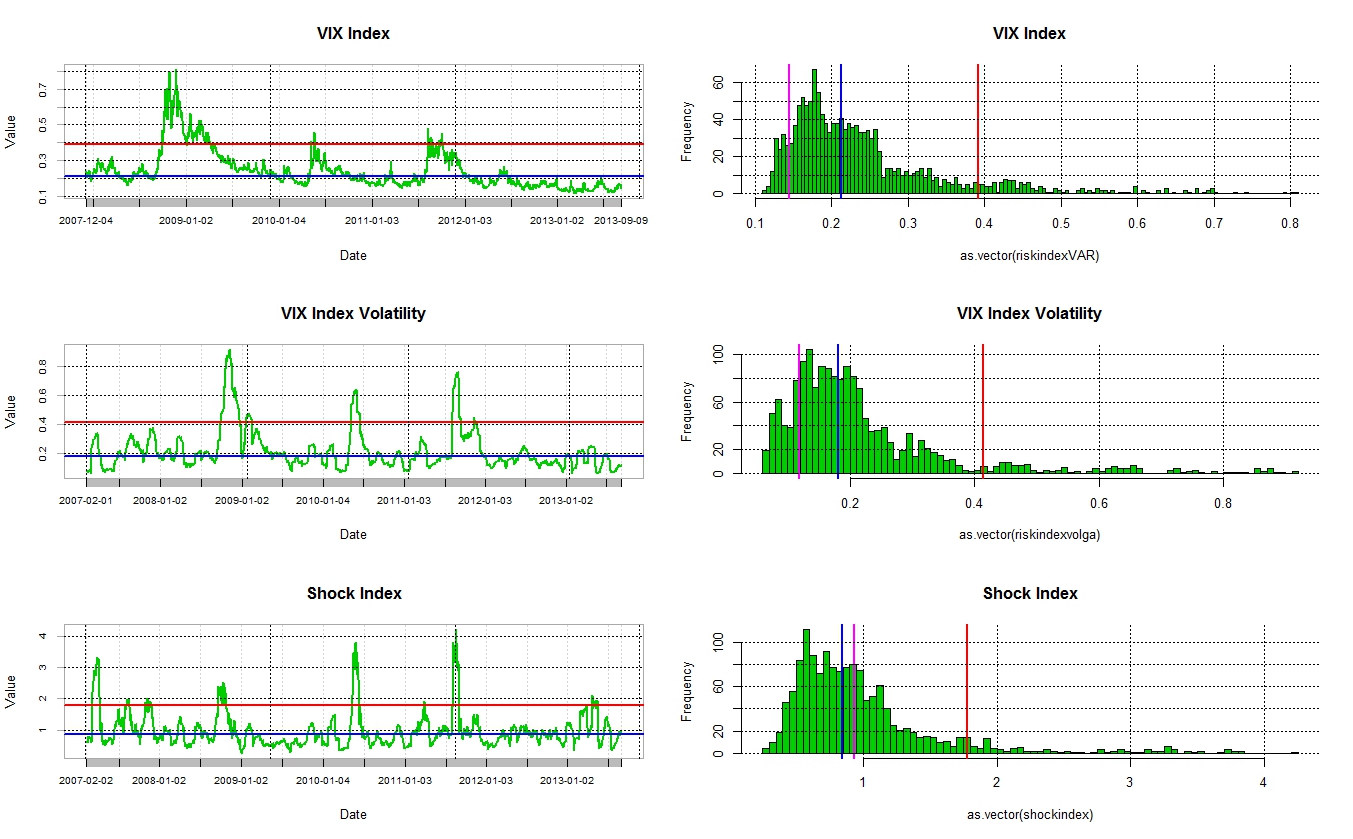
It seems that the risks flagged for September are  slowly vanishing and that the risk agenda is now relatively clear for the remainder of the year. Syria is still a concern but there is now a possible alternative to a direct military intervention which is somehow good news. The German elections are nearing and though some uncertainty remains as highlighted by recent surveys, Merkel remains the likely winner. Of course there is the Fed meeting on the 17th &  18th  and the market eagerly speculating on the semantics of the Fed communique. Tapering or business as usual ? My thought is that all this is overblown and that we have been given a clear path of what will be the Fed monetary policy in the forthcoming cycle…so no real tradable surprise…Anyhow the equity market is taking this pretty well so far as reflected by last month performance and the low level of risk implied by the VIX. So business as usual…long those equity betas and short bonds….macromap11092013 VIX 11092013

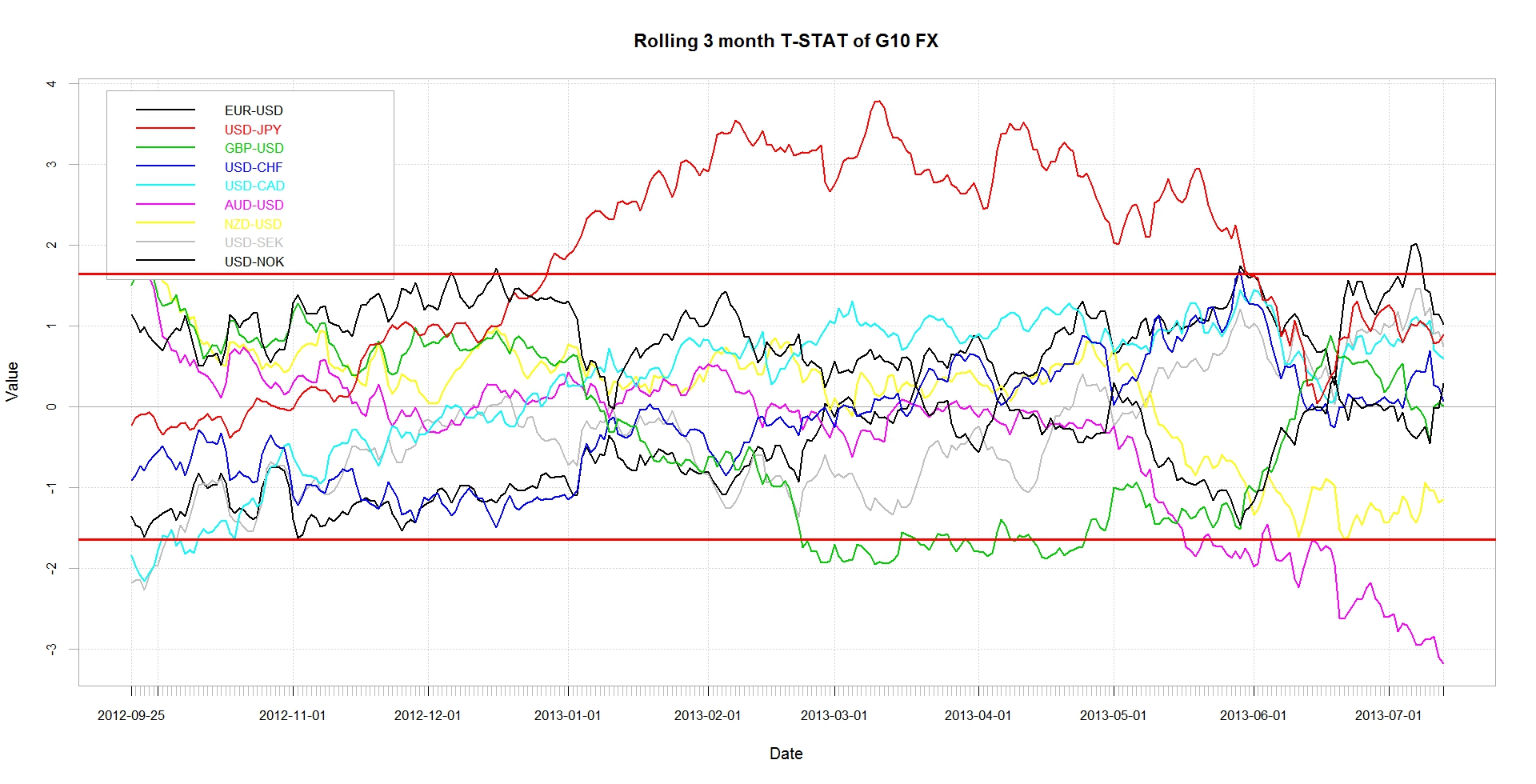
FX market have been correlating fairly well with the equity market and we have seen commodity currencies recovering significantly over the last few sessions . Also the Yen carry trade  still in favour with USDJPY breaking the 100 level. That being said most of the currencies have remained within statistically normal boundaries as indicated by the below charts which show the current  T-Stats for major dollar crosses and also their rolling 3-month T-Stats relative to a 95% confidence interval.

stretchmap 11092013  TOLLING TSTAT 11092013

The below charts shows the sensitivity of the BTOP FX to major dollar exchange rates and therefore and idea of the portfolio content of most FX managers. The USDJPY  seems to be the trade favoured by the speculative community as well as dollar long generally speaking. Maybe more interesting is the second chart that shows an estimate of the leverage used by the FX managers peer group. It is derived by comparing the variance of the BTOPFX index and the Variance of  the estimated sensitivities for an unleveraged portfolio.
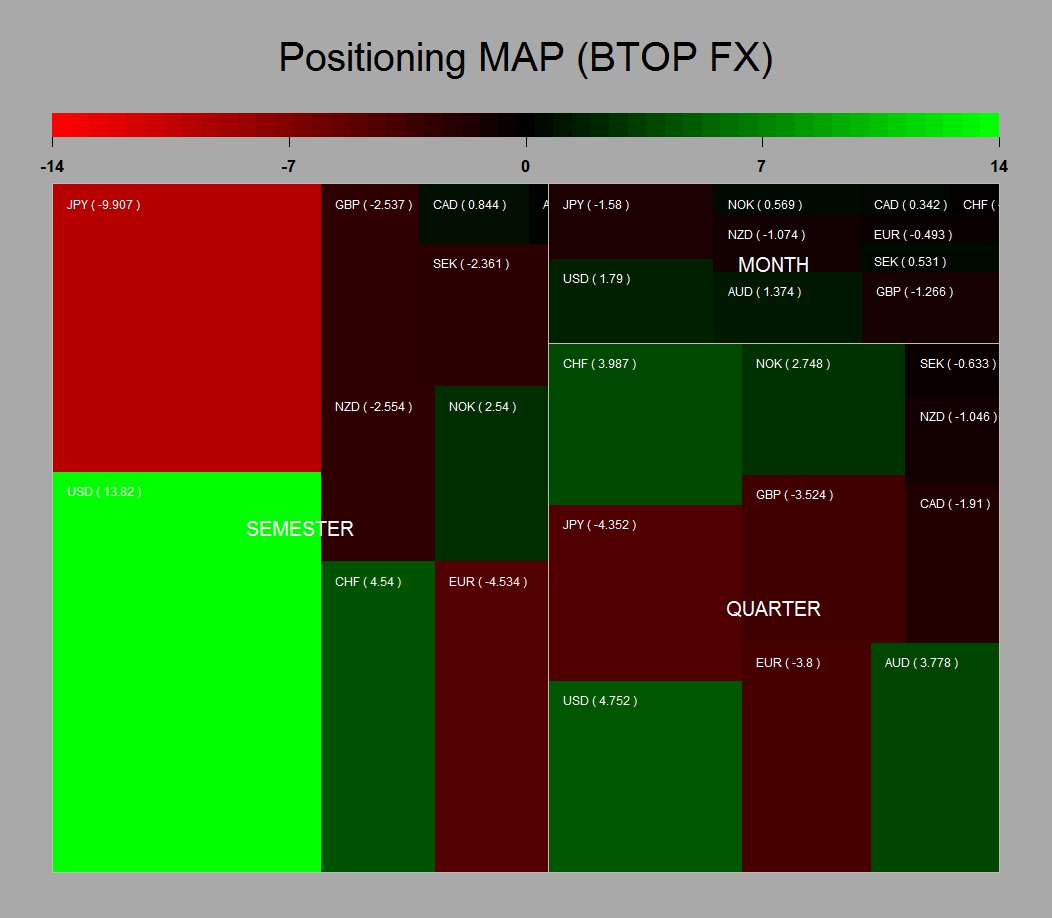
positioning map fx 11092013estimatyed gtearing 11092013

Overall the level of positioning  seems to be pretty average by historical standard. This lead me to think that there are still some good opportunities left in FX going to the end of the year. Assuming that no event comes to spoil the party I would hope to see a continuation of the recent trends…namely a sell off of the dollar as US investors   focus on international opportunities and more upside in yen crosses as they re-leverage…that being said I probably would remain cautious on outright long USDJPY due to the current positioning  and equity flows potentially weighting on the Greenback…

Unrelentless Love for International Equities…..

inflowoutflow06092013Ok the ICI has just released their latest dataset for August and there is no abating for International equities buying by US investors and conversely selling of bonds….

This may explains why the 10 years is currently trading close to a 3% handle…It looks like those payroll data may bring some further volatility to this.cumulative Flows 06092013

As mentioned in my previous posts, I think we are still at  the beginning of the spiral and that we have not as of yet seen much change in the velocity of the asset allocation shift taking place, so I believe all fundamentals being equal there are some good opportunities that remain in my scenario… I am still adding on my equity portfolio and ponder about the future effect of an unavoidable bond market crash…and yes I still think the dollar will weaken as those flows amplify and the appetite for international equities accelerate….


Quick Update on US Mutual Fund Flows….

It looks  like American investors are still switching away from bonds in July as per the recent data of the ICI. I  have put together  a few of my usual charts to visualise this. The appetite for bonds is a mirror of what it is for equities.

mutual funds map 26072013 inflowoutflow26072013

As mentioned in my previous post on the same subject my feeling is that we could see all this impact the strength of the US$ . Many economists out there are entrenched in their scenario of rising yields and GDP for the USD over the medium term with a strengthening of the US$.  Whereas I agree on the rising yields and GDP in the US, I somehow strongly disagree on the effect on the US$. Clearly the world has had a domestic bias since 2008 and this has been reflected on the risk adversity of the average US investor  asset allocation which was primarily dominated by bonds and somehow local equities. If investors become a bit more adventurous , they will start to invest more significantly in international equities (as shown in the above charts) therefore they will need to sell some US$ in the process. In that scenario it may well be that the EURUSD does not present such a bad value at 1.3280……

Time to buy AUDUSD ?

Ok we know that the Australian economy is intimately tied to other Asian economies and particularly China and that growth expectations for China have been dimmed by a tighter monetary policy. However  it strikes me that the Australian dollar has somehow been heavily sold over the last few month when I look at the t-stat of the daily logarithmic changes of the AUDUSD over different time windows. The first chart shows the T-stats of various exchange rates against the US$ over windows of 1 week to 6-month. The second chart shows the rolling 3-month t-stats of daily logarithmic changes of major currencies against the US$. The plotted lines are  95% interval of confidences. Clearly the AUDUSD has been significantly oversold on a statistical basis.

stretch map fx 14072013 fx rolling 3 month t stat

The Australian stock market has held  well relatively to the rest of the world . The recent global surge in equities we have seen is not driven  only by a rotation toward equities due to the fear of central bank rising their interest rates at some time in the not so distant future but also  due to expectation economic growth.

world indices 14072013The oz seems quite cheap  at 0.9050 against the Greenback….tempting….

Are FX Markets Now Efficient ?

I spent a few hours yesterday reacquainting myself with the academic view at the Imperial College  first annual Foreign Exchange Conference. Most of the papers presented there were focussing on carry and crash risk. The change of  market regime observed over the last five years proved irresistible to the academically minded. Surprisingly no talk about momentum  strategies …till  one in the audience popped the question to a panel of illustrious bank economists at the very end of the conference.  Those generally presented a gloomy view of the potential of momentum strategies in generating alpha out of foreign exchange in the current environment. The supporting argument was that the markets had become somehow quicker at translating information and that therefore fewer potential for inefficiency remained. I guess it would be difficult to argue against the fact that markets have become more integrated over the years. This is obviously  due to the advance of communication and transactional technology. Also economies have become generally more open therefore facilitating capital flows. A good way to visualise this is to look at a map of the Globalisation Index compiled by the KOF. The Globalisation index relies on various metric of  economic, social, technological, cultural, political, and ecological data to tell us how integrated and globalised the world is.  From the two charts below you can see that world is somehow more integrated than what it was 40 years ago.

index_1970index_2010

Following this  I thought that it would make sense to look at how the FX markets have behaved in terms of inefficiency over the long term. I did this by classifying the statistical behaviour of 45 exchange rates derived from the G10 US$ exchange rates. To classify them I looked at the 95% significance level of the first autocorrelation and  of the drift over a rolling window of 250 daily logarithmic returns over the period  January 1971  to 2013. I created different bins which I then aggregated under three sub categories, namely Trend, Mean-Reverting and Random.  the Bins are defined as in the following:

classification

Over the whole sample the results shows that the 45 exchange rates have been on average  random 64 %  of the time, mean reverting 20 % of the time and trending  16 % of the time. This means that most of the time it has been very difficult to forecast currencies but that there has been some opportunities to deliver value. What is less encouraging is that the Random behaviour as surged as time went. If we look at the classification over the last 5 years of data it is: 84% random, 9 %  mean reverting and 7 % trending.

classification 2Obviously in this analysis the membership of one currency can change from one period to another and therefore support the argument for more shorter term opportunities. Also true enough in my definition of random ( no significant drift or autocorrelation)  one could generate returns if the market risk premia is low and the interest rate spread is high…..clearly this has not been the case over recent time, market risk as been volatile and spreads have tightened due to the ultra loose monetary policy lead by central banks.  On the topic of momentum the results delivered by the AFX  a naïve momentum strategies which was designed in 1996 has been resilient  and delivered some degree of positive returns though this as arguably diminished  toward zero over the last 5 years.

afx

This may explain in part why active currency managers have had a tough time over the last few years.  So are FX market becoming more efficient ? yes certainly ! Does this means the end of systematic trading or active management as a whole? no certainly not !  Clearly there are some opportunities  for profits  in foreign exchange to generate value. The recent move in the USDJPY and other Yen crosses is a good illustration of this. Also it is likely that central banks will look forward to adjust their monetary policies as the global economy recover. This will create further opportunities in both the carry and momentum space as spread will widen and currency become more directional when interest rates changes.  However I think that for an investment process to capture those opportunities greater time  and effort will need to be spent  R&D on the subject of dynamic style allocation and risk budgeting. Meanwhile other managers relying purely on one specific style will slowly but surely disappear….Dynamic Multifactor Models will remain the essence of good alpha…..

USDJPY Oversold ?

Following my previous blog “Are Equity Markets Overbought ?” I  am now looking at G10 FX using the same methodology. I have therefore adapted my script to download Daily FX rates from FRED.   The Federal Reserve Economic Data   is compiled by the Federal reserve bank of St Louis, a goldmine for you quants out there….Anyhow the results are here below.

map g10fx

g10 rolling t stat

My conclusion from the above charts is as follows: There are no currency in overbought/oversold territory anymore  (G10 FX) . The only culprit was the Japanese Yen which had depreciated against the US Dollar well beyond normal statistical levels. However this has corrected sharply across the last few weeks  with the yen appreciating close to 10%  against the Greenback since May 21st. In fact the Japanese Yen is now significantly overbought against the US Dollar on  both the 1 week and the 1 month time frame with T-Statistics of respectively – 1.99 and – 2.67  for those periods. Bearing in mind that the market may have been a  bit too sanguine in its interpretation of how significantly and speedily the Fed will withdraw liquidity from the market it may well be that USDJPY is the odd one to look for prior tomorrow’s release of the FOMC minutes.  If we are provided with any possible interpretation for a continued dovish policy via the FOMC statement , I would expect to see global equity markets to make some healthy ground and the current correlation between equity and Yen to resume…. USDJPY currently at 95.20 seems cheap to me…….

Japanese Stocks and Yen

It seems that recently we are having a media focus on the relationship between the Yen and the health of the Japanese stock market. Clearly in time of market volatility it is usual practice for analysts and alike to attempt to detect relationships and stick some explanatory variables on it. Someone has to make a living I guess…The current media contention is that the strength the Japanese Yen somehow explains the recent demises of the Japanese stock market. Clearly there may be some degree of truth in this as a stronger Yen would somehow dent the commercial margin of exporters and therefore some degree of correlation should be expected between domestic stock value and Yen (depending on the hedging approach of the underlying companies). That being said, a strong yen would also reduce the cost of importing goods and energy for Japan so overall the effect may be not as pronounced as one would expect.  The below chart shows both the evolution of the Yen and the Nikkei since 1996 and the rolling correlation over a 125-day rolling window of daily returns. There has been a strong increase in the correlation but it still remains below the statistical threshold of significance….. What we observed is also somehow atypical of the whole period where the correlation remained muted and oscillating at levels close to Zero.

correlation nikkei jpy

Rolling 125-day correlation between daily returns of the Nikkei and USD-JPY exchange rate.

Clearly the correlation test focuses on the similarities of the series deviations from their own means, so it does not tell us the story. If the Yen affects the margin of exporters/importers and subsequently the perceived valuation of their stocks, one would expect a causal relationship to be present.  So it is clearly time to go quantitative on this. In the following we look at the 125-day rolling P-values of a  Granger causality test .

pvalues yen nikkei

125-day rolling P-value of Granger Causality test.

Looking at the above results the causal relationship has been instable. True,  as of recent time the value of the Yen seems to drive (cause) the relationship but there has been periods in the past where the Yen has been  significantly strong/weak and this had no effect on the way the causality works. In summary  though there may be a bit of truth in a possible relationship  it is  clearly a weak one. To predict the Nikkei I would rather focus on other factors such as Domestic/Foreign appetite for  Japanese assets in period of renewed economic growth…..