GBPUSD 1-month Implied Volatility and Steepness of Volatility Curve

I was recently reading a paper titled The yen/dollar exchange rate in 1998: views from options markets written by the Bank of England back in November 1998. This got me to think on how I could best represent in one chart the relationship between the slope of the implied volatility term structure of and the nominal level o the 1-month volatility.

To do this I regressed the 1, 3, 6 and 12-month GBP-USD implied volatilies against their time values for the period 1996 to December 2016 (i.e 5427 volatility curves). I derived the volatility curve slopes t_stats for each day and then classified the 1-month volatilities into three groups as a function of the significance level of the slope t-stats. The chart below shows the 1-month implied volatiliy over the full period. When the volatility curve slope was positvely significant at 95% critical threshold the data is shown in green, When there was a signicantly negative slope at the 95% critical threshold the data is shown in red and pale blue for the remainder. I think this is a neat way highlight that time of high volatility are associated with a volatility curve that slope downwardly and vice-versa.

plot of chunk stretch line chart

GBP-USD Update ahead of May’s BREXIT Speech

Whatever the market being traded, there always will be a a question being asked at one moment: How far can  this go ? Clearly not an easy question to answer as this will invariably depends on factors that are partly unknown or difficult to estimate, such as fundamentals, market positioning or market risk amongst others. This  analysis aims to provide an assessments of how atypical the move experienced in GBPUSD is.

The below chart shows the GBP-USD over the period of January 1975 to January 2017 . On the 13 January 2017 it was trading around 1.218472.

plot of chunk chartdata

In the below I plot the previous 125 days against other similar historical periods that would have closely matched the recent history. The data has been normalised so as to be on the same scale. The chart shows the latest 125 days in black, and overlay similar historical patterns in grey. It Also shows what has been the price path for the following 125 days as well as the observed quartiles.

plot of chunk pattern

Finally I plot the last 125 days and a trend forecast derived from an ARIMA(0,1,5) model as well as the 95% confidence intervals. The ARIMA model is fitted to the past 625 historical values whilst ignoring the last 125 days, therefore we can look at the recent price path against the trend forecast and its confidence intervals to gauge how (a)typical the recent move has been.

plot of chunk arimaplot

% Changes of GBPUSD across 250 to 5-day time-horizon – Quick GBP-USD Update ahead of May’s BREXIT Speech….

As a follow up of my previous post on boxplots I thought that I would expand my script to visualise the appreciation/depreciation of one specific values accross differnt time frames. In the below analysis I use the daily GBPUSD exchange rate that I grab from the Bank of England Website.

The blue dots represent the most recent observations for the given time frames, the orange dots are the outliers over the period 1975 to date. The boxes emcompasses the observations that fall between the 25% and 75% quantiles. The Blue lines in the box are the median value over the sample and the “wiskers” represent an interval of close to 95%.


plot of chunk chartdata

% Changes of GBPUSD across 250 to 5-day time-horizon

As a follow up of my previous post on boxplots I thought that I would expand my script to visualise the appreciation/depreciation of one specific instrument accross differnt time frames. In the below analysis I use the daily GBPUSD exchange rate that I grab from the Bank of England Website.

The blue dots represent the most recent observations for the given time frames, the orange dots are the outliers over the period 1975 to date. The boxes emcompasses the observations that fall between the 25% and 75% quantiles. The Blue lines in the box are the median value over the sample and the “wiskers” represent an interval of close to 95%.

The % change is presented in terms of USD relative to GBP. So from the below chart we can see that the USD appreciated by close to 17% against GBP  across the last 250 days which is within a 95% interval of confidence. And so on for other time frames….

plot of chunk chartdata

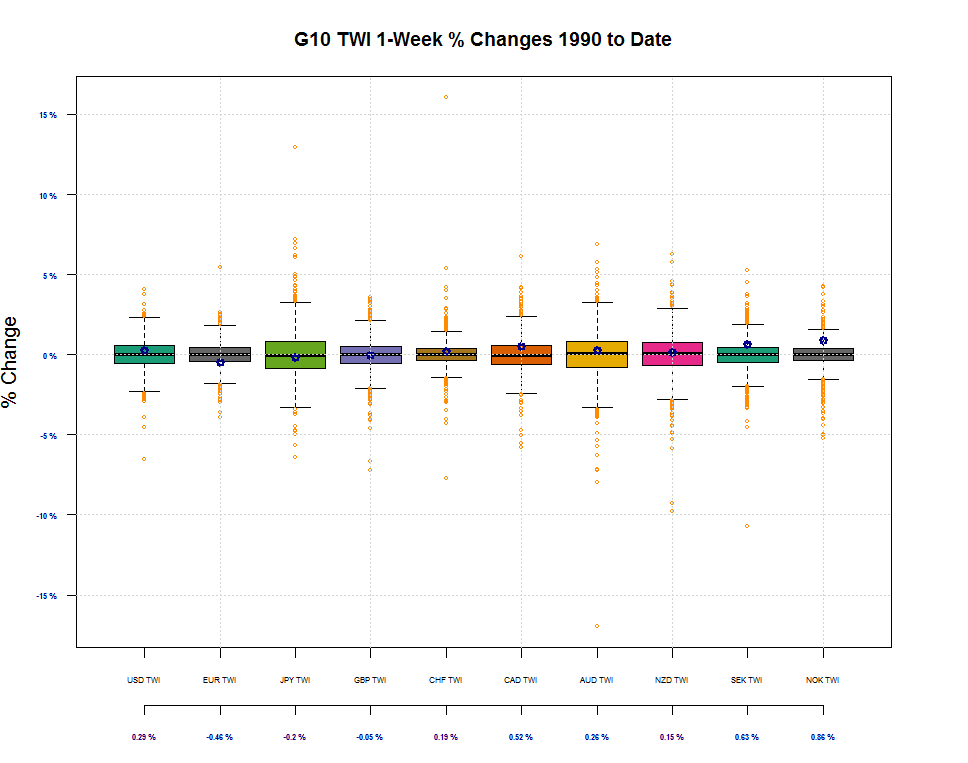
Weekly Changes in G10 FX Trade Weighted Indices

I always liked boxplots. I think they provide a great and very visual way to position current data relative to their history whilst highlighting outliers. This is particularly useful as it helps to put recent moves in context of their past opportunities and possibly highly reversals and/or opportunities. To illustrate this I wrote a quick script in R to grab the BOE G10 Trade weighted indices from the website of the bank of England and posititon the most recent one week move relative to its history of weekly move going back to 1990.
The blue dots represent the most recent observations, the orange dots are the outliers over the period 1990 to date. The boxes emcompasses the observations that fall between the 25% and 75% quantiles. The Blue lines in the box are the median value over the sample and the “wiskers” represent an interval of close to 95%.


AFX Index December Update: Flat Year for Currency Trend Followers …..

Passive currency indices do not reflect any of the money management skills necessary to generate profit out of the Foreign Exchange market. Evidently there is no value in holding a long (or short) position in any currency over the very long term. For this reason passive currency benchmarks fail to adequately describe the performance of currency funds because they do not have an embedded timing process to imitate the short/long currency positions that an active manager would take. For that reason correlation between passive currency indices and currency managers peer group indices tends to be low.

The AFX, aims to replicate the risk/return profile of the average currency manager by using the returns of technical trading rules, namely trend following trading rules. The index was designed by Lequeux & Acar (1998). The timing embedded in the index relies on the buy/sell signals generated by three moving averages. So as to cover a broad spectrum of time horizons the ex-ante statistical properties of technical indicators were used to build the index on the basis of ex-ante measurable criteria of risk reduction and transaction costs. Finally the index uses a weighting scheme derived from the estimated turnover in currency market as reported by the triennial survey on foreign exchange turnover conducted by the Bank for International Settlements. The index is calculated gross of any fee or risk free income and as such express the typical directional market opportunity that was available in G10 FX.

A full description of the index can be found in : Lequeux, P. and Acar, E. (1998) “A Dynamic Benchmark for Managed currencies Funds”, European Journal of Finance Vol. 4.

The historical returns of the AFX Index can be downloaded by through the following link: AFX Historical data

plot of chunk risk_profile

**Summary Performance Statistics

##                                  AFX
## Annualized Return               2.99
## Annualized Standard Deviation   6.79
## Annualized Sharpe Ratio (Rf=0%) 0.44

Drawdowns Table

##          From              Trough         To  Depth Length To Trough
## 1  2015-04-30 2016-09-30 01:00:00       <NA> -15.21        22     22
## 2  2010-11-30 2014-06-30 00:00:00 2015-01-30 -11.48        51     51
## 3  2004-01-30 2004-09-30 00:00:00 2008-10-31 -10.76        58     58
## 4  1993-05-28 1995-01-31 00:00:00 1996-01-31  -7.86        33     33
## 5  1988-01-29 1988-04-29 00:00:00 1988-11-30  -7.79        11     11
## 6  1991-04-30 1991-08-30 00:00:00 1991-12-31  -7.17         9      9
## 7  2009-01-30 2009-04-30 00:00:00 2010-05-31  -6.26        17     17
## 8  1992-01-31 1992-04-30 00:00:00 1992-07-31  -5.77         7      7
## 9  2002-07-31 2002-11-29 00:00:00 2003-05-30  -5.68        11     11
## 10 1989-06-30 1989-10-31 00:00:00 1990-07-31  -5.58        14     14
##    Recovery
## 1        18
## 2        44
## 3         9
## 4        21
## 5         4
## 6         5
## 7         4
## 8         4
## 9         5
## 10        5

Monthly Returns

##       Jan  Feb  Mar  Apr  May  Jun  Jul  Aug  Sep  Oct  Nov  Dec YEARLY
## 1984 -0.6 -0.7 -0.7  0.0  0.8  1.4  4.1 -1.7  3.9 -0.9  0.9  1.9    8.5
## 1985  1.5  4.0 -1.5 -2.3 -0.4 -0.3  6.7 -1.5 -1.5  2.1  3.3  0.0   10.1
## 1986  1.4  5.0 -1.3  2.2 -1.1  0.3  3.7  0.1 -1.3  1.0 -0.9  0.8    9.9
## 1987  3.2  0.1  2.3  1.7 -1.6 -1.9  1.7 -0.1 -0.5 -0.2  4.7  5.0   14.3
## 1988 -5.8 -0.3 -0.2 -1.6  1.3  4.2  1.8  0.7 -1.5  0.9  3.1 -2.9   -0.2
## 1989  3.1 -2.5  3.1 -0.3  5.6 -0.5 -1.6 -0.9 -1.6 -1.1  0.8  2.2    6.4
## 1990 -0.4  0.5  0.7 -0.1  0.1 -1.2  3.8  1.1 -0.2  3.3 -0.6 -1.4    5.7
## 1991 -1.8 -1.1  7.9 -1.8 -0.9  2.3 -2.7 -4.2  3.6 -1.6  1.9  5.3    7.0
## 1992 -4.5 -1.0  0.8 -1.1  0.5  3.8  1.7  3.7 -0.6 -0.7  1.7 -0.7    3.6
## 1993 -2.8  2.0  0.5  2.6 -0.1 -1.2 -0.5 -3.3  0.1  0.0 -0.2 -0.4   -3.3
## 1994 -1.5  0.3  1.4 -0.4 -0.9  2.9 -1.1 -1.5 -0.2  1.8 -1.2 -1.1   -1.5
## 1995 -0.8  1.7  6.5  0.2 -3.8 -2.0 -0.5  4.9 -1.1  0.7 -0.9 -0.1    4.7
## 1996  3.3 -1.8  0.6  2.0  0.4  0.3 -0.1 -1.0  0.8  1.8  0.2  1.4    7.9
## 1997  4.0  1.3 -0.3  1.3 -2.6  0.7  2.3 -0.9 -0.4  0.1  1.5  0.1    7.2
## 1998 -0.7 -2.1  2.6 -1.3  1.5 -0.5 -0.8 -1.9  0.9  4.7 -2.5  0.1    0.1
## 1999 -0.4  0.7  0.7  0.6  0.7 -0.5 -0.5 -0.8  0.2 -0.8  2.4 -0.5    1.8
## 2000  1.8  0.8 -0.7  1.4 -1.1 -1.7 -0.2  1.9 -0.7  2.0 -0.6  4.4    7.3
## 2001 -0.3 -1.4  2.6 -2.1  0.8 -0.5 -1.0  1.8 -0.9 -0.6 -0.5  0.3   -2.0
## 2002  1.3 -1.9 -1.3  0.3  2.6  4.7 -0.4 -1.5 -1.7 -1.6 -0.6  2.8    2.8
## 2003  1.2 -0.5 -0.5  0.1  2.9 -1.9 -1.1  0.7  0.7  0.3  0.7  3.0    5.7
## 2004 -0.5 -0.4 -1.0 -0.7 -1.0 -1.8 -1.3 -3.0 -1.5  2.0  3.3  0.3   -5.7
## 2005 -2.7 -0.4  0.0 -0.2  2.6  2.2  0.2 -1.6  0.6  0.3  1.6 -1.7    0.7
## 2006 -1.4 -0.9 -1.6  1.9  1.2 -1.1 -0.6  0.6 -0.1 -0.2  1.9 -0.5   -0.8
## 2007 -0.1 -0.9 -0.8  1.2 -0.4  0.1  0.3 -1.0  1.6  0.6  0.6 -1.3   -0.3
## 2008  0.7  0.9  2.8 -2.5 -1.5 -1.9 -0.7  4.2 -0.9  8.8  1.5  0.3   11.5
## 2009 -1.1 -0.4 -2.2 -2.8  4.5 -0.7 -0.6 -0.7  1.6 -0.8  0.8 -0.7   -3.0
## 2010  0.7  1.3  0.1 -0.3  3.1 -0.7  0.7  0.1  1.1  1.4 -0.7 -1.7    5.0
## 2011 -1.3  0.2  0.3  3.0 -3.2 -1.6 -0.2 -2.9  3.2 -4.1 -0.2  2.0   -4.8
## 2012 -0.9  0.8 -0.6 -1.2  3.3 -3.3  0.8 -1.1  1.2  0.4 -0.1  2.2    1.5
## 2013  2.1 -0.2  0.7 -1.8 -0.5 -2.6 -0.4 -1.5  1.5 -0.5  0.3  1.8   -1.2
## 2014 -2.6  0.2 -0.9 -0.9 -0.2 -0.1  0.5  1.4  3.5  0.7  2.5  1.4    5.5
## 2015  2.5 -0.3  1.9 -1.3 -1.0 -2.5 -0.7 -1.2 -0.5 -1.5  2.3 -3.4   -5.6
## 2016 -0.7  0.6 -0.6  0.6 -1.3 -1.3 -1.1 -0.9 -1.9  1.4  3.6  1.3   -0.3

The AFX is positively correlated to main peer group indices highlighting that currency managers are typically directional in their investment style. The below charts shows the 24-month rolling correlation of the AFX with the BTOP FX Index .

plot of chunk rolling_correl

If you need more information or have questions about the above, feel free to contact me at pollux@argonautae.com

Growing Randomness of Currency Markets…

Back in 20114 I wrote a chapter for The Role of Currency in Institutional Portfolio by Professor Levich and M. Pojarliev.In my research I debated about the growing efficiency in foreign exchange markets potentially making a more arid ground for active managers to generate alpha. Clearly some could argue about the timing of my publication on the subject as since then some strong trends have occurred in US$ crosses. In fact the last quarter of 2014 proved to be a significant localised alpha bonanza for many currency managers. This fed into much enthusiasm from managers and a regain of interest for active currency management. However since then those trends have abated and it is lean times again for currency managers who use single factor strategies. Anyhow, my study focus on long term dynamics and the secular growing efficiency of market which I suggest is driven by a cocktail of world globalisation and advances in information technology. This has enhanced in an unprecedented way the availability of information, access to market and provided a level field market pricing to market participant.

In a seminal paper Emmanuel Acar laid the theoretical background demonstrating that the expected return of directional trading rules can be attributed mainly to autocorrelations (i.e. how the daily returns of an asset are correlated from one period to another) and drift (i.e. the absolute percentage deviation of the price series). In my paper I proposed a methodology based on his finding to classify financial time price series. The below shows what was the drift, autocorrelation and volatilities of the 45 G10 FX cross exchange rates over the period 1996 to 2015.

plot of chunk unnamed-chunk-2 plot of chunk unnamed-chunk-2 plot of chunk unnamed-chunk-2
Using significance tests for the drift and first order autocorrelation of the time series over a rolling windows of 125 days it is possible to classify each of the 45 G10 FX crosses into 6 specific behaviours, namely: Strong trend, strong mean reversion, short term trend, Long term trend + short term reversion, Long term trend + white noise, random walk. More details on this can be found in my paper. In the below I have aggregated the time dimension (i.e. long and short term) so as to end up only with three states: Trending, Mean Reverting and Random walk. The bar chart shows the percentage of time that each currency pair spent in each of those state. It is quite apparent that some currencies have had a greater propensity to trend than other (i.e. US$ and JPY crosses) and also that currencies spent most of their time in a random walk state. It is still possible to generate value in the later as long as the risk is compensated by a high level of carry. Clearly this has not been the case over recent time and may explain why so many currency managers had poor perfpormace.

plot of chunk unnamed-chunk-3
The following chart shows the number of US$ crosses that have been in trending regime over the previous 750 days. It is quite clear that aside the last quarter of 2014, trends have been seldom.

plot of chunk unnamed-chunk-4

Finally, the last charts shows the number of currencies that would have been classify as trending, mean reverting or random on a rolling basis since the seventies. It is quite clear that currencies have become more random over the last few decades. This in turn means that currency manager performance has become far much more dependent on the level of carry and volatility. I am always happy to have a natter about what I produce so feel free to contact me at Pierre@Argonautae.co.uk.

plot of chunk unnamed-chunk-5


G10 FX Implied Volatilities: Cheap or Expensive ?

The following report provides a granular analysis of implied volatilities within G10 FX. I use primarily the same formatting than for my G10FX positioning report to estimate how extended the 1-month FX implied volatilities are over various time horizon.

The first set of charts shows the historical T-stat of the 1-day changes in 1-month implied volatilities over a rolling period of 61-days. This is my statistical metric to quantify how stretched the implied volatilities are, but clearly other time period could be used as shown further down on in that report. The purple line represents the median value since 1996 and the red lines represent the 95% confidence intervals. Therefore if the value is above or below those the deviation of the given implied volatility should be deemed as atypical relative to what would be expected under a normal distribution (I am not saying that implied volatilities have a normal behaviour to be clear….) and therefore overbought/oversold.

plot of chunk stretch line chart

The below charts shows the current implied volatilities relative to their historical distributions since 1996. Once again the red lines delimit the 95% confidence intervals and the purple line the median value. The blue line indicates the most current level of 1-month implied volatility.

plot of chunk stretch distribution

Finally the below shows a stretch map of the T-Stats to help visualise how much implied volatilities have departed from their equilibrium levels over time horizons ranging from 1-month to 6-month. The bigger the square the most significant the observed upside (Green) or downside (Red) of the implied volatility over the given period.

plot of chunk stretch map

Chinese Stock Market Risk Report Update

The following report provides an update on some of the metrics I use to classify market risk. The word classify is more appropriate as I think that in essence you cannot forecast risk but rather attempt to adjust to it into a timely fashion. Clearly risk would not be a risk if you could forecast it accurately. However as there is generally some degree of persistence in risk regimes, using a dynamic classification may be a useful approach for portfolio rebalancing and hedging. In this report I use the CBOE China ETF Volatility Index (VIX China) as a measure of stock market risk for China . The same methodology can be successfully applied to other inputs. Feel free to contact me at Pierre@argonautae.com for more information on the subject.

In my approach I recognise that the nominal level of implied volatility is a crude metric of risk therefore I also use two other measures. The VIX Volga, a measure of uncertainty of risk and the ShockIndex a measure of market dislocation. VIX Volga is simply the volatility of the VIX China over a given period. This measure highlights how uncertain and unstable the level of risk has become. Though positively correlated to the level of the VIX China the VIX China Volga is not necessarily dependent on it. You can have a high level of volga whilst the VIX China is trading at rather innocuous levels. This is not a trivial observation as the leverage undertaken by market participants tends to be an inverse function of market volatility which implies a greater vulnerability when volatility becomes uncertain at low levels and therefore cannot be accurately budgeted fo r. The ShockIndex is the ratio between the Volga and VIX at the beginning the historical window chosen to evaluate the Volga. It quantifies sharp changes and acceleration in risk levels. Historically it has proven to be a good classifying measure for market event risks.

The below charts shows those three measures both relative to a time axis and their historical distribution. The red lines are the 95% confidence intervals, the purple line the median. The blue line highlight the current level. The VIX Volga and ShockIndex in this report are evaluated over a period of 14 days. The medians and 95% confidence intervals are calculated over the full history going back to 1990 though the charts shows only the recent years.

plot of chunk riskchart

At close of business the 2016-12-30 the VIX China was trading at 24.6 at the 41 percentile. The 14-day VIX China Volga was estimated at 13.1 its 46.6 percentile and the China shockindex at 0.6 or its 56.1 percentile.

The above charts are useful, however their visualisation is quite limiting. On the one hand we need quite a few charts to present the data on the other hand it is difficult to show the full VIX history going back to 1990 as this would make the charts unreadable. Therefore clustering and aggregating the whole data into a single chart should be useful to the end user. To answer this I use a mapping technique developed by Kohonen in the 1980′. It uses an unsupervised neural network to re-arrange data around meaningful clusters. Though computationally complex is a practical way to summarise multidimensional data into a low (usually 2) dimensional system.

The below chart shows how the VIX price history was split into 4 distinct clusters. Those clusters where computed not only as a function of the VIX level but also as a function of the other variables, namely VIX volga and Shockindex.

Since 03/2011 the VIX China traded 53 % of the time in Cluster 1, 30 % in Cluster 2, 13 % in Cluster 3 and 4 % in Cluster 4. Overall the layering provided seems quite intuitive as the increase in risk and time spent in each cluster points toward what would generally be expected from market risk regimes ranging from low to high risk.

plot of chunk cluster_chart

In the chart below we zoom on the various regimes within which the VIX has been trading for the current year. so far it traded 80 % of the time in Cluster 1, 20 % in Cluster 2, 0 % in Cluster 3 and 0 % in Cluster 4.

plot of chunk ytdriskchart

Finally the below chart shows a Self Organising Map of the above mentioned risk metrics. The data has been grouped and colored as a function of four clusters of increasing market risk regimes. Obviously as shown on the map, the minimum level of volatility pertains to cluster 1 and the highest to cluster4. The current regime and its progression from 21 days ago is also highlighted on the map.

plot of chunk SOM_chart

Always happy to discuss any of the above, feel free to reach me at: Pierre@argonautae.co.uk

Trade Weighted Currency Indices Stretch Map

Trade Weighted Currency Indices Report

Sat Dec 31 09:06:54 2016

The following report aims to provide a gauge to the current strenght of major currencies. For doing so I use the Bank of England Trade weighted Exchange rate indices and a standardised statistical measures of price deviation to provide an estimate of how stretched major currencies are on a trade weighted perspective.

plot of chunk linechart

I first calculate the T-stat of the mean price deviations over a rolling period of 61 days. The charts below show the results for each currency over the last 500 days. The purple line represents the median value since 1990-01-03 and the red lines represent the 95% confidence intervals. Therefore if the value is above or below those the deviation of the given currency would be deemed as atypical relative to what #would be expected under a normal distribution and therefore overbought/oversold.

plot of chunk rolling chart

The following Map chart shows how stretched the currencies are over time horizons ranging from 1-month to 1-year. The bigger the square the most significant the upside (green) or downside (red) of currencies over the given period.

plot of chunk stretch map
The charts below show how the daily changes in the Trade weighted indices have correlated since January 1990 and since the begining of 2015.

plot of chunk correlation
Finally, the following provide an ARIMA forecast for each of the trade weighted indices. My script selects the best ARIMA fit over the previous 250-day to generate a forecast for the next 21 days.
It also shows the forecast confidence intervals.

plot of chunk arimaforecastplot of chunk arimaforecastplot of chunk arimaforecast